


Understanding the Ancient Kedah Kingdom

Long before modern Kedah became known as Malaysia’s “rice bowl”, its rivers, estuaries, and foothills formed one of the most important early trading zones in the Malay Peninsula. The Ancient Kedah Kingdom, often linked with Bujang Valley and old names such as Kataha, Kadaram, and possibly Chieh-cha, connected local communities with India, China, the Middle East, and the wider Malay world.
This was not a kingdom built only on palaces and armies. Its power came from geography, trade, iron, river routes, religious exchange, and the skill of people who understood how to live between mountain, sea, and monsoon.

Ancient Kedah grew from a strategic place
Ancient Kedah sat in a location that traders could not ignore. To the west lay the Straits of Malacca and the Bay of Bengal. Inland, rivers led towards the foothills of Gunung Jerai, a major landmark visible to sailors approaching the coast.
For early seafarers, Gunung Jerai mattered. Before modern navigation, a high mountain near the coast acted like a natural signpost. Ships moving between India and Southeast Asia could use it to find safe routes, river mouths, and stopping points.
Kedah also gave traders access to the overland passage across the Malay Peninsula. Goods could move from the west coast towards the east coast through river systems and portage routes. This helped connect the Indian Ocean world with the South China Sea without forcing every vessel to sail around the peninsula.
The kingdom’s strength came from this position. It was close enough to major sea lanes to attract merchants, yet connected enough inland to gather forest products, minerals, food, and labour.
Ancient Kedah likely developed through several related settlements rather than one single city. Archaeological remains in the Bujang Valley show that the area held religious sites, ports, workshops, and settlement zones over many centuries. This pattern fits the way many early Southeast Asian polities worked. Power often gathered around river mouths, temple zones, trade centres, and elite networks instead of a fixed capital in the modern sense.
Bujang Valley shows how deep its history runs
Bujang Valley, or Lembah Bujang, is central to understanding Ancient Kedah. Located around the Merbok River basin and nearby areas, it contains one of the richest archaeological records in Malaysia.
The most famous remains are temple structures known locally as candi. These were built from materials such as brick and laterite, and many show Hindu-Buddhist influence. The forms vary, but they point to long contact with Indian religious ideas, art, and ritual practice.
These sites do not mean Ancient Kedah was simply “Indianised” in a one-way process. A better reading is that local rulers and communities adopted, adapted, and reshaped ideas that helped them express status, sacred authority, and connection with the wider trading world.
The Bujang Valley also produced finds such as ceramics, beads, inscriptions, stone objects, and trade goods. Some came from distant regions. Others were locally made. Together, they show that Kedah was both a receiver and a producer.
One of the most discussed sites in recent Malaysian archaeology is Sungai Batu, near Merbok. Archaeological work there has revealed evidence of iron smelting, jetty-like structures, brick features, and settlement activity. Researchers have linked the area with early industry and river-based exchange. While interpretations and dating can be debated, the site has strengthened the view that Ancient Kedah had a complex economic base, not just passing trade.

The candi were more than religious buildings
The candi found in Bujang Valley were sacred spaces, but they also had political meaning. In many early Southeast Asian societies, religion and rulership were closely linked. A ruler who supported religious building could present themselves as powerful, blessed, and connected to wider civilisations.
The presence of Hindu and Buddhist elements suggests close links with Indian merchants, priests, monks, and cultural networks. Sanskrit terms, ritual objects, and religious imagery could travel with people and goods.
At the same time, local beliefs did not simply disappear. Southeast Asian societies often blended new religious forms with older ideas linked to land, ancestors, spirits, mountains, and water. Gunung Jerai, river mouths, and coastal zones likely carried meanings that were both practical and sacred.
Trade made Kedah wealthy and connected
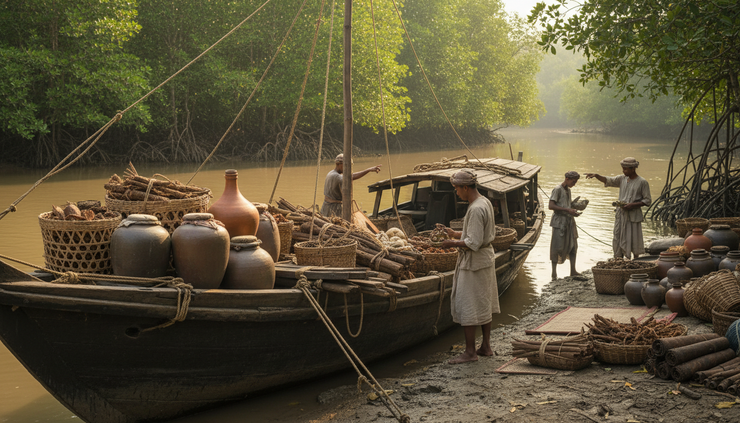
Ancient Kedah was an entrepot, a place where goods could be collected, stored, exchanged, and redistributed. Merchants did not always travel from one end of Asia to the other in a single journey. They often moved through linked ports, waiting for monsoon winds and trading along the way.
Kedah benefited from the monsoon system. Seasonal winds made travel across the Indian Ocean and Southeast Asian waters more predictable. Traders could arrive, wait, sell, buy, repair ships, and continue when winds changed.
Goods that passed through or were linked with Kedah likely included:
Forest products such as resins, aromatic woods, and medicinal materials
Tin and other minerals from the peninsula
Iron products or raw materials connected with local industry
Ceramics and luxury goods from China and elsewhere
Beads, textiles, and religious objects from India and the Indian Ocean world
Food supplies needed by ships and port communities
Kedah’s role was not only to receive foreign traders. Local people organised production, transport, storage, and exchange. River communities, craft workers, farmers, boat builders, and rulers all formed part of the system.
Name used in sources | Possible connection | What it suggests |
Kataha | Indian references | Links with the Indian Ocean world |
Kadaram | Tamil and regional references | A known port-polity in the Malay Peninsula |
Chieh-cha | Chinese records, often associated with Kedah | Recognition by Chinese observers and traders |
Kalah or related names | Arabic and Persian geographic traditions | Kedah’s place in wider maritime knowledge |
These names are not always simple matches. Ancient texts used different languages, spellings, and assumptions. Still, the repeated appearance of names linked to Kedah shows that the region was known beyond the peninsula.
Ancient Kedah stood within a larger Malay world
Ancient Kedah did not exist in isolation. It stood among other early Malay and Southeast Asian polities, including those linked with Funan, Srivijaya, Langkasuka, and later regional powers.
Srivijaya, centred around Sumatra, played a major role in maritime Southeast Asia from around the 7th century onwards. Kedah appears to have been part of the same connected world of ports, tribute, Buddhism, trade, and sea power. At times, Kedah may have been under Srivijayan influence or linked through alliance and dependency. At other times, it may have acted with more autonomy.
The 11th century brought a major event often associated with Kedah’s history. In 1025, the Chola ruler Rajendra Chola I launched naval attacks on several places connected with Srivijaya’s network. Tamil inscriptions mention Kadaram, which is widely linked with Kedah. This shows that Kedah mattered enough to be named in a major overseas campaign.
The Chola attack did not erase Kedah. Instead, it shows how valuable the region was. Ports that controlled movement, goods, and alliances attracted both traders and rivals.
Foreign contact did not remove local identity
A common mistake is to imagine Ancient Kedah as a passive stopover shaped only by India, China, or larger empires. The evidence points to something more interesting.
Kedah’s people selected what was useful. They absorbed religious forms, trade practices, writing systems, technologies, and elite symbols. Then they used them in local ways.
This is why Ancient Kedah matters in Malaysian history. It shows that the Malay Peninsula was not a quiet edge of civilisation. It was an active meeting point where local communities helped shape regional history.
Religion, culture, and daily life were closely linked
The religious life of Ancient Kedah reflected its trading links. Hinduism and Buddhism both left marks in the archaeological record. Images, structures, and ritual spaces suggest that merchants, monks, priests, rulers, and local communities all played roles in spreading and practising these traditions.
Bujang Valley’s candi remind us that religion was not limited to personal belief. It shaped art, architecture, authority, calendar rituals, and ideas of sacred geography. A temple near a river route could serve both a spiritual and social function. It marked a place as important.
Daily life, though harder to reconstruct, would have been practical and demanding. People farmed, fished, gathered forest products, worked metal, carried goods, built boats, and managed river transport. Some lived close to ports. Others worked inland and supplied the coast.
Iron production deserves special attention. Evidence from Sungai Batu has led many scholars and heritage observers to discuss Kedah as an early industrial area. Smelting required knowledge of materials, heat, labour, and distribution. If iron goods moved through Kedah’s trade networks, then the kingdom’s economy was more than a middleman system.
The society likely included rulers, religious specialists, merchants, craft workers, farmers, sailors, and labourers. It also likely included foreigners who lived temporarily or permanently in port areas. A busy port could hold many languages and customs, especially during trading seasons.

The legacy of Ancient Kedah still matters
Ancient Kedah’s legacy is not only found in museum cases or temple ruins. It shapes how Malaysia understands its early history.
For a long time, public history in the region often focused on later sultanates, colonial records, and modern nation-building. Ancient Kedah pushes the timeline back. It shows that organised trade, religious exchange, craft production, and political authority existed in the peninsula long before the colonial period.
It also helps explain why Kedah became so historically important in later centuries. The emergence of the Kedah Sultanate did not happen in an empty place. It grew in a region with deep experience in settlement, trade, sacred kingship, and external diplomacy.
The transition to Islam later changed Kedah’s political and cultural identity. Traditional accounts connect the conversion of a Kedah ruler to the founding of the Muslim sultanate, often associated with Sultan Muzaffar Shah. These stories carry cultural importance, though historians treat dates and details with care. What is clear is that Kedah’s older Hindu-Buddhist and trading past formed part of the ground on which later Islamic rule developed.
Today, sites in Bujang Valley and Sungai Batu help Malaysians see history as layered. A single region can hold prehistoric activity, Hindu-Buddhist remains, early industry, Islamic traditions, colonial records, and modern life. Kedah is one of the best examples of that depth.
Preserving these sites matters because they are fragile. Brick foundations, iron-working remains, beads, ceramics, and inscriptions can be damaged by neglect, development, or careless handling. Archaeology needs patience. Once a site is destroyed, its evidence cannot be replaced.
The Ancient Kedah Kingdom tells a larger story about Southeast Asia. Power did not only come from conquest. It also came from knowing the winds, reading rivers, producing valuable goods, welcoming traders, and giving sacred meaning to place.
Ancient Kedah was a bridge between worlds: the Indian Ocean and the South China Sea, inland producers and coastal merchants, local traditions and foreign religions, early industry and maritime trade. Its history belongs not only to Kedah, but to Malaysia and the wider region.
To understand Ancient Kedah is to see the Malay Peninsula as an active centre of exchange, creativity, and authority. The ruins may be quiet now, but they point to a past that was connected, skilled, and remarkably important.
Comments